Selecting an aerial work platform involves more than choosing a machine that reaches the required height. Contractors, rental companies, and procurement teams must also consider platform load, horizontal outreach, transport dimensions, and the space available at the jobsite. A mismatch between these factors can lead to access problems, extra transport costs, or delays once equipment arrives.
A practical buyer checklist helps teams compare machines against real operating requirements. For projects involving high façades, industrial structures, or large construction sites, an elevated work platform should be assessed by its complete working envelope and transport configuration, not by its headline lifting height alone.
Confirm the Required Working Height and Outreach
The first step is to establish how high the work must be performed and how far the platform needs to reach horizontally. Buyers should distinguish working height from platform height. Working height typically includes an assumed operator reach above the platform, so these figures should not be treated as interchangeable.
Horizontal outreach is equally important when the machine must remain away from a building, cross an obstacle, or reach an elevated work area beyond its base. A telescopic boom lift can be appropriate for applications requiring substantial straight-line outreach, but buyers should confirm the manufacturer’s reach diagram rather than relying on maximum height alone.
Project teams should also account for ground elevation, obstacles, and the position from which the machine can safely operate. Selecting sufficient reach for the actual task helps prevent crews from repositioning equipment repeatedly or discovering that a target area falls outside the machine’s working envelope.
Check Platform Capacity and Working Configuration
Platform capacity determines how much combined weight the machine can carry safely. Buyers should include operators, tools, accessories, and materials in their calculations. They must also check whether the rated capacity changes with boom position or outreach, since some machines have different limits for restricted and unrestricted operating envelopes.
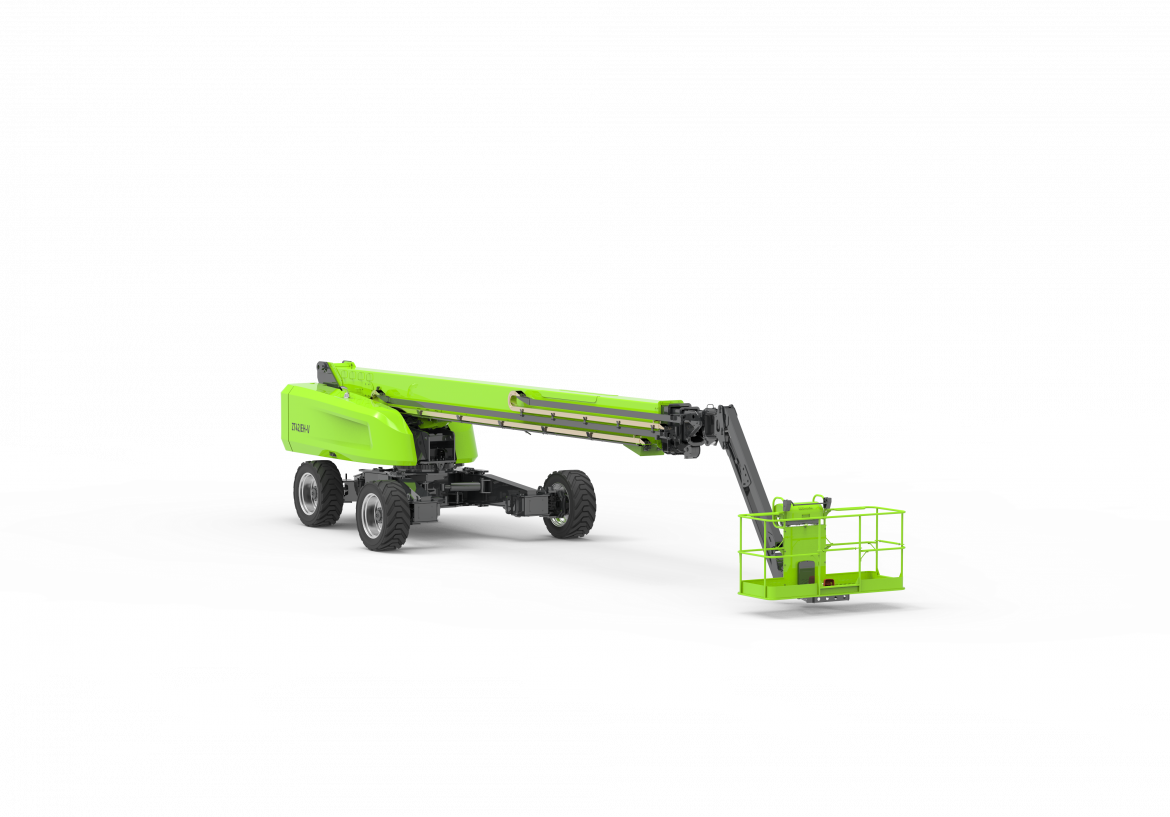
The Zoomlion Access ZT38JEH, for example, lists platform capacities of 300 kg and 454 kg. Procurement teams should confirm which rating applies to the intended configuration and consult the load chart before assigning tasks. An elevated work platform must never be selected on the assumption that its highest capacity is available throughout the full working envelope.
Platform dimensions matter as well. A larger deck may provide more room for workers and equipment, but the load must remain within rated limits and be distributed according to the operator’s manual. Buyers should match the platform to the actual task rather than choosing capacity solely as a general measure of machine size.
Measure Stowed Size Before Arranging Transport
A machine’s working performance is only part of the purchasing decision. Stowed dimensions affect transport planning, access through site entrances, storage, and movement between projects. Buyers should check the overall length, width, and height of the machine in its specified transport configuration.
The ZT38JEH has a published stowed length of 14.95 m, width of 2.49 m, and height of 2.86 m. Its gross weight is 20,800 kg. These figures should be compared with transport vehicle limits, loading arrangements, route restrictions, and site access conditions before delivery is scheduled. A machine that fits the work area may still require special transport planning.
A telescopic boom lift also needs enough space to maneuver after arrival. Turning radius, tail swing, ground clearance, and the available setup area can influence whether it reaches the work zone efficiently. Buyers should therefore assess the complete route and operating space, not simply the width of the entrance.
Review Power, Site Conditions, and Operating Costs
The power system should match the project’s working environment and expected duty cycle. Buyers should consider charging or refueling arrangements, daily operating hours, maintenance access, and any restrictions on emissions or noise. Tire type, ground clearance, and gradeability also matter when the machine must travel over outdoor surfaces.
The ZT38JEH is an extended-range hybrid model with an 80 V, 608 Ah battery, a 30 kW lift motor, and foam-filled tires. Its listed gradeability is 45%, subject to the manufacturer’s specified conditions. These details help procurement teams evaluate the machine’s suitability, but site gradients, surface stability, and operating limits must still be checked before deployment.
An elevated work platform should also be evaluated over its service life. Buyers can compare purchase or rental costs, scheduled maintenance, transportation, parts availability, and expected utilization to understand the total cost of ownership. A machine with suitable reach and capacity is more valuable when its operating requirements also fit the contractor’s resources.
A Practical Checklist for Confident Equipment Selection
The most effective buying decision balances working height, horizontal outreach, platform capacity, stowed dimensions, and operating conditions. Contractors should verify each specification against actual site measurements and task requirements before comparing quotations.
The Zoomlion Access ZT38JEH illustrates why the full specification matters: it combines a 40.1 m maximum working height, 25 m horizontal outreach, dual platform capacity ratings, and clearly defined transport dimensions. By checking these details alongside access routes, load requirements, and lifecycle costs, B2B buyers can select a telescopic boom lift that fits both the job and the logistics behind it.